Yesterday, I was pleasantly surprised by a story, written and posted by the Associated Press, about the expanding influence of women in the church. Entitled "Mormon women's influence expands despite priesthood ban," it highlights the progress women have made in the church since the first spark of the Restoration. Baby steps? Yes. But also very solid, inspiring ones.
Sharon Eubank: The Revolution within an Evolutionary Church
In my opinion, no one personifies this progress better than Sharon Eubank, who is shown atop the article in a photo of her sitting beneath portraits of past General Relief Society Presidents. Although she is not herself such a president, she is currently First Counselor in the General Relief Society, president of Latter-day Saint Charities (the church's humanitarian arm) and is the church's de facto Ambassador to the United Nations (go here and here to read my previous posts about her UN associations).
In my opinion, you have to travel back in time to Emma Smith to find a woman as potentially influential in the church as Sharon Eubank. Just as Emma was instrumental in the early, formative steps of the church, Sharon is perhaps the point person in helping the church obtain respect and acceptance among world leaders, especially the United Nations, its non-governmental organizations and the Catholic church.
She is not only influential, but unique as well. As the AP story points out, Eubank "is neither married nor a mother but glad to embody a different image of womanhood as one of the top female leaders in the male-dominated faith widely known as the Mormon church." In a church and a (Utah-centric) society where temple marriage is equated with exaltation, her status as a single woman (confirmed by the church here) - in such elevated levels of leadership - is striking.
The Ring of a Thousand Questions
Intrigued by the articles I've linked to above, I sat down today to watch a few of the General Conference addresses she's given. And it's there that I saw something which confused me:
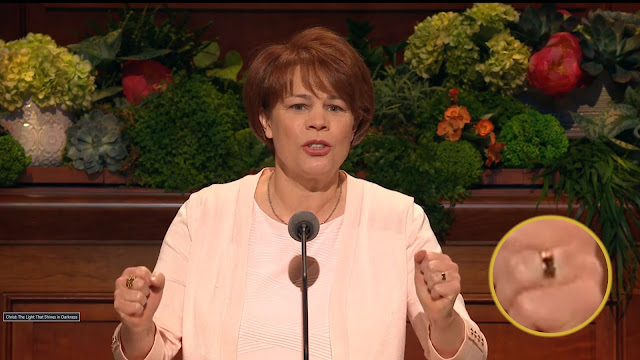
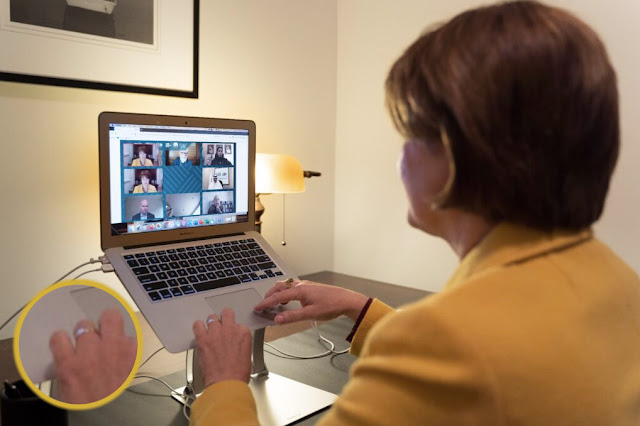
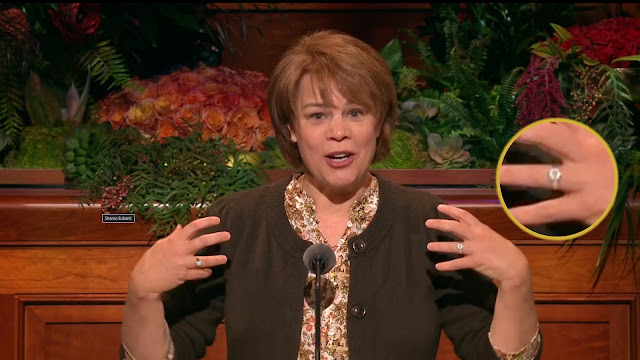
Sharon Eubank is wearing a ring on her left-hand ring finger…in not one, but two Conference addresses and one international forum.
Right now, I'm reminded of one of my most memorable conference moments of all time.
It was the Sunday Morning Session, April 5, 2021 General Conference. As you can see in the video below (at the 48:28 mark), President Oaks thanked "the Brethren for your great messages." This was after Sister Reyna Aburto had also spoken.
(My bet: It has become so normalized that conference talks are given by men, that it isn't surprising he forgot to include her in his comments).
The Essentiality of Women in the Church
Despite that little mix-up, the Church reportedly needs and values women a great deal. Here is what President M. Russell Ballard said at a BYU Women's Conference on May 1, 2015:
"For years I have spoken about the power of councils with faithful women participating. Your insight and counsel are absolutely essential." [1]
A month earlier, Pres. Nelson said this in the April 2015 Conference:
"We, your brethren, need your strength, your conversion, your conviction, your ability to lead, your wisdom, and your voices. The kingdom of God is not and cannot be complete without women who make sacred covenants and then keep them, women who can speak with the power and authority of God!" [2]
Elder Neil L. Andersen also said this during the October 6, 2013 General Conference Afternoon Session (which, ironically, had no women's voices included):
"Sincerely asking for and listening to the thoughts and concerns voiced by women is vital in life, in marriage, and in building the kingdom of God." [3]
In the October 1996 Conference, Pres. Hinckley said,
"You sisters do not hold a second place in our Father's plan for the eternal happiness and well being of His children. You are an absolutely essential part of that plan." [4]
He also stated in the same conference,
"In this Church the man neither walks ahead of his wife nor behind his wife but at her side. They are co-equals in this life in a great enterprise." [5]
President Spencer W. Kimball said,
"When we speak of marriage as a partnership, let us speak of marriage as a full partnership. We do not want our LDS women to be silent partners or limited partners in that eternal assignment! Please be a contributing and full partner" [6]
Lastly, he also said,
"… It will be … female exemplars of the Church [who] will be a significant force in both the numerical and the spiritual growth of the Church in the last days." [7]
All that "Essentiality" at Conference
Unfortunately, that "significant force" of women doesn't exist in the upper echelons of the church.
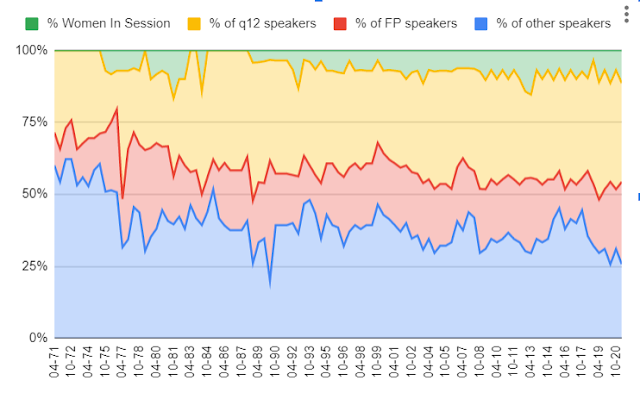
In the 1980s and beginning the 1990s, generally one woman spoke per conference (unless an organization president was released). Around 2002, the number went up to three female speakers. [8], [9]
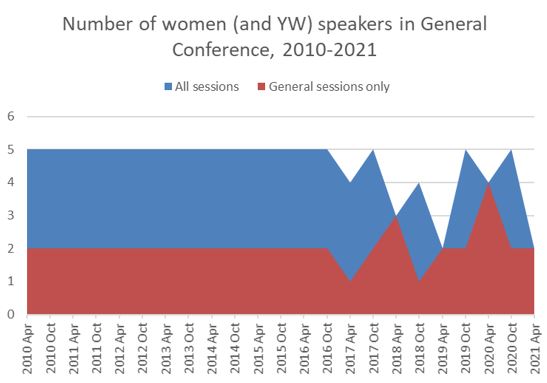
Since 2010, women have typically delivered between 1 and 4 (usually 2) General Conference addresses:
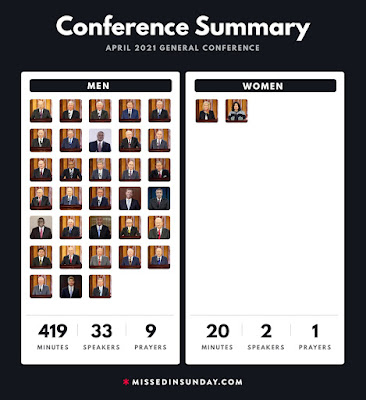
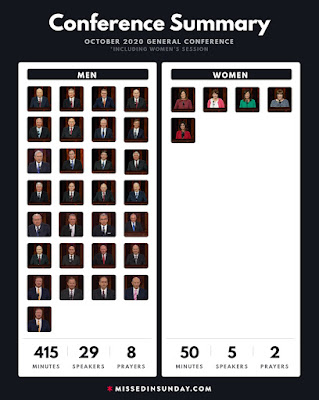
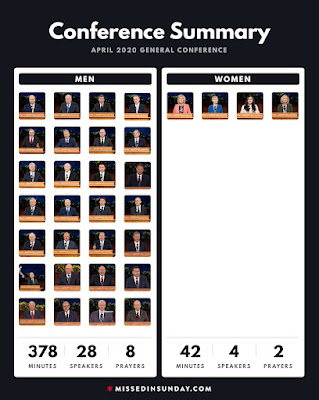
Please check out these pictures. Does anything look a little lop-sided to you?
missedinsunday.com
So, I think the evidence is pretty obvious: On one hand, the church says we need to listen to women. But on the other hand, it consistently invites disproportionately fewer women to speak.
How are we supposed to hear them if they're hardly speaking?
The church wants to continue to be able to say that women are important…without actually showing it.
It says how important women are, but then treat women as some kind of afterthought. Women are so important that the speaking ratio is abysmally male-centric.
Tough Questions…Lame Answers?
Looking at this data above might lead you to ask at least one of the following questions:
"Why do we have to hear from each member of the First Presidency more than once?"
"Why can't the Relief Society Presidency speak every time?"
"Why can't at least one woman from the Primary and Young Women speak every conference?"
"Why do we have to hear from so many of the 12?"
"With over 1/2 the church membership female, why can't we have something closer to equal representation?"
When the Salt Lake Tribune asked about the drought in female conference speakers, Church spokesman Eric Hawkins had no comment, saying only that the governing, three-man First Presidency "assigns the speakers" and "there are no quotas." [10]
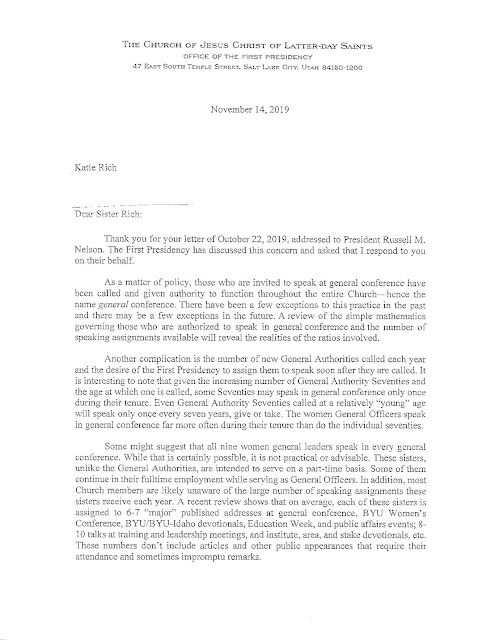
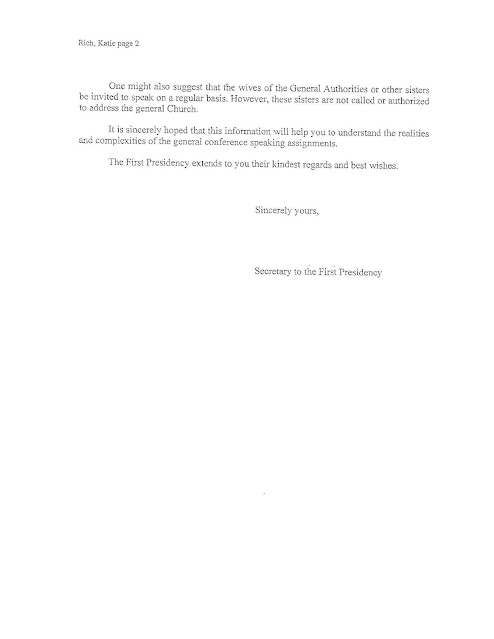
But in November 2019, one person - Katie Rich - wrote and sent a letter to the First Presidency about the conference speakers' gender inequity, and received a (comparatively lengthy) response (you may have to zoom to read these): [11]
In my opinion, the First Presidency's responses are pathetic, insulting, hurtful and disempowering. They send a message that (1) it's OK to talk out of both sides of your mouth, (2) hypocrisy among leaders is acceptable behavior and (3) women do not have a meaningful place among the church's top leadership (at least during General Conference).
One could say, "Why do you care about the speaker's gender? The Spirit is the real teacher, and its instruction can come through a man or a woman equally." They could also say, "God is no respecter of persons so it doesn't matter to God (nor should it matter to you) if women speak or not." Also, "Why aren't you trusting the Lord/sustaining the Brethren who call people to speak?"
However, by minimizing womens' voices in General Conference,
Women, girls, men and boys are free to increasingly believe that women have little to no worthwhile spiritual development insights (let alone value, intellect and skills) at any level of church government, even the local level.
Fewer female speakers means fewer female quotes in church talks and lessons. Following that lead, the General Authorities, Stake Presidents and Bishops are less compelled to strive for greater parity when selecting teachers, speakers and leaders.
I find it ironic that the First Presidency would say that "As a matter of policy, those who are invited to speak at general conference have been called and given authority to function throughout the entire church."
First, three auxiliaries - Primary, Young Women and Relief Society - have three female presidency members each. That's nine speakers. Each of these auxiliaries have general boards, which are themselves comprised of many more women. Finding a total of 20 female speakers (who have been "given authority to function throughout the entire church") shouldn't be a problem.
Secondly, President Nelson has demonstrated significant enthusiasm for policy changes. If the First Presidency wanted to change General Conference speaker composition, they easily could.
Third, I'm bewildered why a sister might have reason to be precluded from speaking in General Conference just because she's working full-time.
The curtailing of women serving in more church leadership positions is one of the greatest hinderances for growth in the church. How can the church possibly hope to make greater strides with potential female convert baptisms when its disdain for female leadership is readily apparent to the world every six months?
A Lose-Lose Situation
It's clear that the Brethren are conflicted as to what to do. For example: Speaking of sisters, Pres. Ballard said this at a Europe Area Sisters' Meeting on September 9, 2014:
"That you will let your voices be heard, we cannot, we cannot meet our destiny as the Church of Jesus Christ of Latter-day Saints in preparing this world for the 2nd coming of the Savior of the world without the support and the faith and the strength of the women of this church. We need you. We need your voices. They need to be heard." [ https://www.youtube.com/watch?v=WSWPrzICnlQ ]
He next said:
"Don't talk too much in those [ward or branch] council meetings. Just straighten the brethren out quickly and move the work on."
So, in other words, we need your voices! Now don't talk too much...
(Pres. Ballard has left the door open to shut down any woman who tries to "straighten the brethren out." All they have to do is claim she's talking "too much" and BOOM. Nobody will hear a word she says from then on. Kinda like this YouTube: https://www.youtube.com/watch?v=LS37SNYjg8w).
Thus, if women speak out, they'll be criticized for speaking out of turn (outside their authority in the patriarchal hierarchy). If they don't, they'll be criticized for not speaking up. A perfect set-up for being gaslighted.
As one sister said,
"Our leaders say: Sustain and obey your priesthood leaders.
Our leaders say: Don't steady the ark.
Our leaders say: Don't criticize the brethren, even if they're wrong.
Our leaders say: Sisters, step forward, speak up, we need your inspiration.
Obeying that last directive requires going against a lot of cultural conditioning.
As long as our model is patriarchal, partnership is impossible, and women will continue to choose silence over unsolicited assertiveness." [12]
President Oaks was the keynote speaker for SUPer DUPer Day on Monday, July 19, an annual celebration at This Is the Place Heritage Park for the families of the Sons of Utah Pioneers and the Daughters of Utah Pioneers. [1]
His talk emphasized the need for us modern-day saints to identify the eternal principles the pioneers applied for our benefit, and then apply those principles to the challenges of our own day.
When I think of the pioneers, I contemplate concepts such as strenuously hard work, dedication, conservative family values and a deep, abiding faith in the Lord.
I'm sure Pres. Oaks would agree with those aforementioned concepts. In fact, he would add one to the list as well:
"Inclusion."
That's right - "the practice or policy of providing equal access to opportunities and resources for people who might otherwise be excluded or marginalized, such as those who have physical or mental disabilities and members of other minority groups." [2]
Pres. Oaks told the Church News after the event that "We live in a time when inclusion is needed - in political relations, in cultural relations, in legal relations - and it's not forthcoming in our society. As a Church and as a culture, we need to lead out in demonstrating inclusion, not dissent, diversity, diversion or opposition."
I couldn't agree more with Pres. Oaks. I'm not sure how he's defining "our society," but assuming it's the church's society, then yes, I believe the church does have some work to do in closing the gap between itself and those who are excluded and/or marginalized.
Who might comprise these groups?
Women? Yes. I recently reviewed the speaker-by-gender counts for the most recent five General Conferences. Here is what I found:
General Conference Speakers
April 2021: 28 men, 1 woman (3.5%)
October 2020: 26 men, 2 women (7.6%)
April 2020: 30 men, 4 women (13.3%)
October 2019: 26 men, 2 women (7.6%)
April 2019: 23 men, 2 women (8.6%)
Total: 133 men, 11 women (8.2%)
Blacks? Yes. In July 2019, a church news release said that "Over the past 18 months, the First Presidency has made its partnership with the NAACP a high priority." [3] So, how is that high priority doing in the two years since that news release?
Not good. The Church recently purchased a hotel in Maui for $148 million [4] and bought the Easterday ranch properties in eastern Washington for $209 million [5] -- over a third of a billion dollars in (known) real estate acquisitions within a month. (There has been no announcement yet as to how these acquisitions further the church's four-fold mission). [6] These combined amounts dwarf (by a factor of 37) the $9.25 million in donations the church is making to the NAACP/UNCF (over a three year period). [7] The facts make it crystal clear: the church places a higher value on land acquisition than it does helping out human beings who have been historically marginalized.
Gays? Members still cannot be baptized if their parents are gay and married, and the member-child refuses to discredit their parents' lifestyle.
The less fortunate? Yes. In his address, Pres. Oaks noted the Church's 3,600 humanitarian projects ministering to people in 160 countries during 2020. As of March 26, 2021, Latter-day Saint Charities and its affiliates had provided over $2.5 billion worth of assistance in 199 countries and territories since 1985. [8] Assuming the church still has somewhere north of $100 billion in liquid assets, that would mean that the church is not even close to donating what it requires its members (10%) in tithing.
The unmasked/unvaccinated? Yes. I have documented here and here how the church, especially local church leaders, are not only excluding unvaccinated members from enjoying full participation in the church, but also painting them as unfaithful members and uncaring Christians. Also, within the last few weeks, prospective BYU-Hawaii freshman Olivia Sandor was rejected admission to the school because she has a condition which makes getting the jab extremely dangerous. Despite a team of medical practitioners submitting a medical exemption for her, BYU administration rejected her exemption - not once, but twice. Please, Pres. Oaks, describe how these actions are indicative of the "inclusion" you spoke about. [9]
Do "We live in a time when inclusion is needed"? It appears so.
Does that "Church and as a culture" "need to lead out in demonstrating inclusion, not dissent, diversity, diversion or opposition"? Definitely.
I look forward to Pres. Oaks "leading out" on the issue of inclusion (with respect to the groups I named) as soon as possible.
Otherwise, the church has another word to deal with besides "inclusion":