Print Friendly and PDF

Monday, October 11, 2021

All About Who *Didn't* Speak (very much) in the October 2021 General Conference

Ahhhh yes, General Conference.

Right now, I'm reminded of one of my most memorable conference moments of all time.

It was the Sunday Morning Session, April 5, 2021 General Conference. As you can see in the video below (at the 48:28 mark), President Oaks thanked "the Brethren for your great messages." This was after Sister Reyna Aburto had also spoken.


(My bet: It has become so normalized that conference talks are given by men, that it isn't surprising he forgot to include her in his comments).

The Essentiality of Women in the Church

Despite that little mix-up, the Church reportedly needs and values women a great deal. Here is what President M. Russell Ballard said at a BYU Women's Conference on May 1, 2015:

"For years I have spoken about the power of councils with faithful women participating. Your insight and counsel are absolutely essential." [1]

A month earlier, Pres. Nelson said this in the April 2015 Conference:

"We, your brethren, need your strength, your conversion, your conviction, your ability to lead, your wisdom, and your voices. The kingdom of God is not and cannot be complete without women who make sacred covenants and then keep them, women who can speak with the power and authority of God!" [2]

Elder Neil L. Andersen also said this during the October 6, 2013 General Conference Afternoon Session (which, ironically, had no women's voices included): 

"Sincerely asking for and listening to the thoughts and concerns voiced by women is vital in life, in marriage, and in building the kingdom of God." [3]

In the October 1996 Conference, Pres. Hinckley said, 

"You sisters do not hold a second place in our Father's plan for the eternal happiness and well being of His children. You are an absolutely essential part of that plan."  [4]

He also stated in the same conference, 

"In this Church the man neither walks ahead of his wife nor behind his wife but at her side. They are co-equals in this life in a great enterprise." [5]

President Spencer W. Kimball said, 

"When we speak of marriage as a partnership, let us speak of marriage as a full partnership. We do not want our LDS women to be silent partners or limited partners in that eternal assignment! Please be a contributing and full partner" [6]

Lastly, he also said,

"… It will be … female exemplars of the Church [who] will be a significant force in both the numerical and the spiritual growth of the Church in the last days." [7]

All that "Essentiality" at Conference

Unfortunately, that "significant force" of women doesn't exist in the upper echelons of the church. 

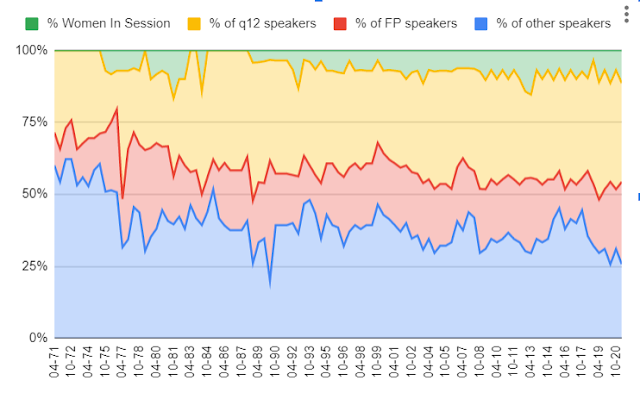
In the 1980s and beginning the 1990s, generally one woman spoke per conference (unless an organization president was released). Around 2002, the number went up to three female speakers. [8], [9]

Since 2010, women have typically delivered between 1 and 4 (usually 2) General Conference addresses: 
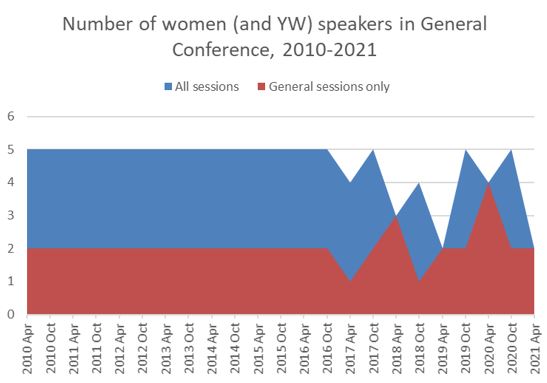
https://zelophehadsdaughters.com/category/general-conference/

Which means in the aggregate that they give roughly 10% of the conference talks: 
https://millionthingsihaventdone.com/data-analysis/women-in-general-conference/

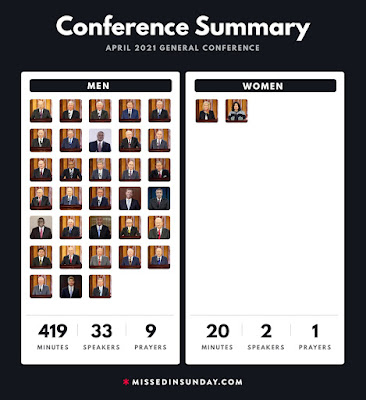
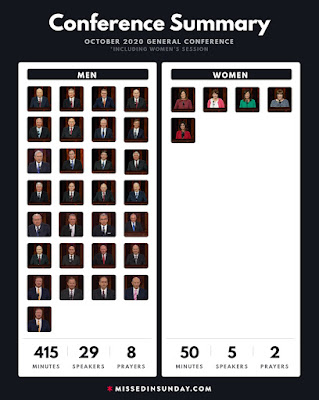
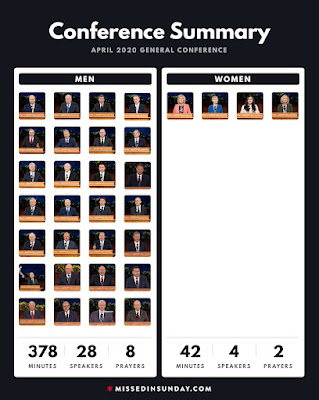
Please check out these pictures. Does anything look a little lop-sided to you?  


missedinsunday.com

So, I think the evidence is pretty obvious: On one hand, the church says we need to listen to women. But on the other hand, it consistently invites disproportionately fewer women to speak.

How are we supposed to hear them if they're hardly speaking?

The church wants to continue to be able to say that women are important…without actually showing it.

It says how important women are, but then treat women as some kind of afterthought. Women are so important that the speaking ratio is abysmally male-centric.

Tough Questions…Lame Answers?

Looking at this data above might lead you to ask at least one of the following questions:

  • "Why do we have to hear from each member of the First Presidency more than once?" 
  • "Why can't the Relief Society Presidency speak every time?"
  • "Why can't at least one woman from the Primary and Young Women speak every conference?"
  • "Why do we have to hear from so many of the 12?" 
  • "With over 1/2 the church membership female, why can't we have something closer to equal representation?"

When the Salt Lake Tribune asked about the drought in female conference speakers, Church spokesman Eric Hawkins had no comment, saying only that the governing, three-man First Presidency "assigns the speakers" and "there are no quotas." [10]

But in November 2019, one person - Katie Rich - wrote and sent a letter to the First Presidency about the conference speakers' gender inequity, and received a (comparatively lengthy) response (you may have to zoom to read these): [11]
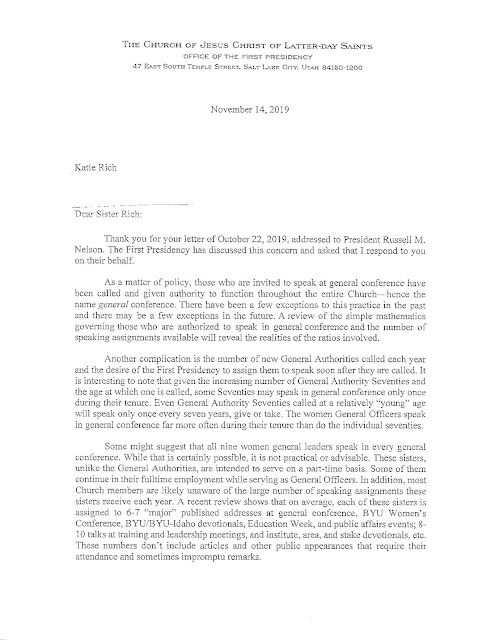
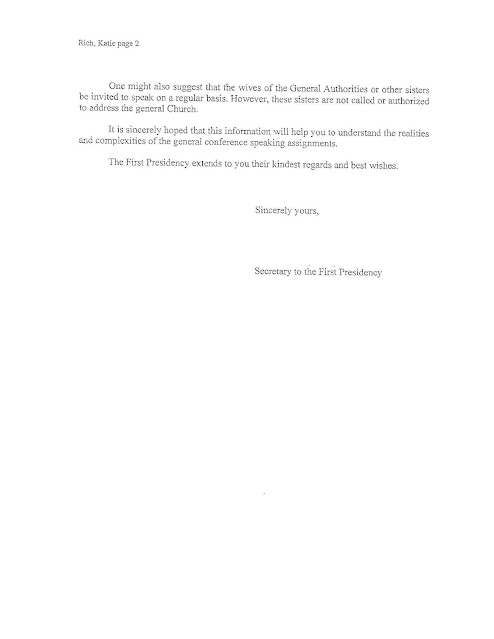
In my opinion, the First Presidency's responses are pathetic, insulting, hurtful and disempowering. They send a message that (1) it's OK to talk out of both sides of your mouth, (2) hypocrisy among leaders is acceptable behavior and (3) women do not have a meaningful place among the church's top leadership (at least during General Conference).

One could say, "Why do you care about the speaker's gender? The Spirit is the real teacher, and its instruction can come through a man or a woman equally." They could also say, "God is no respecter of persons so it doesn't matter to God (nor should it matter to you) if women speak or not." Also, "Why aren't you trusting the Lord/sustaining the Brethren who call people to speak?"

However, by minimizing womens' voices in General Conference, 

  • Women, girls, men and boys are free to increasingly believe that women have little to no worthwhile spiritual development insights (let alone value, intellect and skills) at any level of church government, even the local level.
  • Fewer female speakers means fewer female quotes in church talks and lessons. Following that lead, the General Authorities, Stake Presidents and Bishops are less compelled to strive for greater parity when selecting teachers, speakers and leaders.
I find it ironic that the First Presidency would say that "As a matter of policy, those who are invited to speak at general conference have been called and given authority to function throughout the entire church." 

  • First, three auxiliaries - Primary, Young Women and Relief Society - have three female presidency members each. That's nine speakers. Each of these auxiliaries have general boards, which are themselves comprised of many more women. Finding a total of 20 female speakers (who have been "given authority to function throughout the entire church") shouldn't be a problem. 
  • Secondly, President Nelson has demonstrated significant enthusiasm for policy changes. If the First Presidency wanted to change General Conference speaker composition, they easily could. 
  • Third, I'm bewildered why a sister might have reason to be precluded from speaking in General Conference just because she's working full-time.

The curtailing of women serving in more church leadership positions is one of the greatest hinderances for growth in the church. How can the church possibly hope to make greater strides with potential female convert baptisms when its disdain for female leadership is readily apparent to the world every six months?

A Lose-Lose Situation

It's clear that the Brethren are conflicted as to what to do. For example: Speaking of sisters, Pres. Ballard said this at a Europe Area Sisters' Meeting on September 9, 2014:

"That you will let your voices be heard, we cannot, we cannot meet our destiny as the Church of Jesus Christ of Latter-day Saints in preparing this world for the 2nd coming of the Savior of the world without the support and the faith and the strength of the women of this church. We need you. We need your voices. They need to be heard." [ https://www.youtube.com/watch?v=WSWPrzICnlQ ]

He next said:

"Don't talk too much in those [ward or branch] council meetings. Just straighten the brethren out quickly and move the work on."

So, in other words, we need your voices! Now don't talk too much...

(Pres. Ballard has left the door open to shut down any woman who tries to "straighten the brethren out." All they have to do is claim she's talking "too much" and BOOM. Nobody will hear a word she says from then on. Kinda like this YouTube: https://www.youtube.com/watch?v=LS37SNYjg8w).

Thus, if women speak out, they'll be criticized for speaking out of turn (outside their authority in the patriarchal hierarchy). If they don't, they'll be criticized for not speaking up. A perfect set-up for being gaslighted.

As one sister said,

"Our leaders say: Sustain and obey your priesthood leaders.

Our leaders say: Don't steady the ark.

Our leaders say: Don't criticize the brethren, even if they're wrong.

Our leaders say: Sisters, step forward, speak up, we need your inspiration.

Obeying that last directive requires going against a lot of cultural conditioning.

As long as our model is patriarchal, partnership is impossible, and women will continue to choose silence over unsolicited assertiveness." [12]

Sources

  1. https://www.churchofjesuschrist.org/study/liahona/2021/03/the-essential-role-of-women?lang=eng
  2. https://www.churchofjesuschrist.org/study/general-conference/2015/10/a-plea-to-my-sisters?lang=eng
  3. https://www.churchofjesuschrist.org/study/general-conference/2013/10/power-in-the-priesthood?lang=eng 
  4. https://www.churchofjesuschrist.org/study/general-conference/1996/10/women-of-the-church?lang=eng
  5. https://www.churchofjesuschrist.org/study/general-conference/1996/10/this-thing-was-not-done-in-a-corner?lang=eng 
  6. The Teachings of Spencer W. Kimball, p. 315-316
  7. https://www.churchofjesuschrist.org/study/general-conference/1979/10/the-role-of-righteous-women?lang=eng
  8. https://archive.sltrib.com/article.php?id=5148693&itype=CMSID#gallery-carousel-446996
  9. https://juvenileinstructor.org/we-shall-now-call-on-some-of-our-sisters-lds-women-and-general-conference-participation
  10. https://archive.sltrib.com/article.php?id=5148693&itype=CMSID#gallery-carousel-446996
  11. https://www.the-exponent.com/guest-post-calling-more-women-to-speak-at-general-conference-a-response-to-the-office-of-the-first-presidency
  12. https://www.the-exponent.com/the-impossible-position-of-lds-women-unsolicited-assertiveness


Saturday, October 2, 2021

Is the Church a cult? Let's look at it objectively.


It's a fascinating question: 

"What are the characteristics one would expect to find in a cult?"

Why do we think "cult" is a bad word? The base definition is "a system of religious veneration and devotion directed toward a particular figure or object. " In my opinion, the word isn't necessarily bad; rather, it's the attributes of the group (which are often irrational) which make it good or bad, safe or dangerous.

Once those characteristics and/or attributes are identified, the next question to ask might be, "Is the LDS Church a cult?"

For many decades, many have said that it is. 

But in my opinion, much like beauty, cult status may be in the eye of the beholder. After all, no church wants to be categorized as a cult. I mean, that puts them right up there with NXIVM, Heaven's Gate, Branch Davidians, Jonestown, Scientology and more, right?

Regardless, if you're in a cult, the perception is that not only are you whacked, but you're also helping to perpetuate the influence and power of the cult's chief whack-a-doodles as well. That's why there needs to be authoritative, objective criteria to determine if an organization is an actual cult.

Let's see what's out there, what works and what doesn't.

The BITE Model

What are the specific methods cults use to recruit and maintain control over people?

Steven Hassan's BITE Model may provide some answers.

Hassan's bio can be found here. I'll admit: With a resume including a PhD, M.Ed. and LMHC, who am I to argue with his credentials? Still there are others, like cults expert Rick Alan Ross, who dispute details of Hassan's resume.

And even beyond Hassan, one difficulty with the BITE Model is that it is supposedly only accepted by a fraction of all psychologists/sociologists of religion. But (1) even though the BITE Model may not be the academic gold standard, it does resonate with a lot of people and (2) BITE is based on research and theory by experts who studied brainwashing in China. So, while "BITE" may not have the credentials, the info it's based on certainly does. A quick Google search will bring up the info needed.

Which leads us to Hassan's book, "Combating Cult Mind Control." It provides a framework for assessing how cult-like an organization is (or isn't).  In it, he describes his BITE Model, which categorizes cult-like behavior into four domains:

Behavior Control,
Information Control,
Thought Control, and
Emotional Manipulation and Control.

Here's a video which explains BITE Model basics:


Now let's put this evaluation to practice. Below are the four components of the BITE model. Each point has a checkbox. Feel free to check any boxes you are absolutely positive are applicable to the LDS Church. 

Behavior Control

[ ] Regulate individual's physical reality
[ ] Dictate where, how, and with whom the member lives and associates or isolates
[ ] When, how and with whom the member has sex
[ ] Control types of clothing and hairstyles
[ ] Regulate diet - food and drink, hunger and/or fasting
[ ] Manipulation and deprivation of sleep
[ ] Financial exploitation, manipulation or dependence
[ ] Restrict leisure, entertainment, vacation time
[ ] Major time spent with group indoctrination and rituals and/or self indoctrination including the Internet
[ ] Permission required for major decisions
[ ] Rewards and punishments used to modify behaviors, both positive and negative
[ ] Discourage individualism, encourage group-think
[ ] Impose rigid rules and regulations
[ ] Punish disobedience by beating, torture, burning, cutting, rape, or tattooing/branding
[ ] Threaten harm to family and friends
[ ] Force individual to rape or be raped
[ ] Encourage and engage in corporal punishment
[ ] Instill dependency and obedience
[ ] Kidnapping
[ ] Beating
[ ] Torture
[ ] Rape
[ ] Separation of Families
[ ] Imprisonment
[ ] Murder

____ / 25

Information Control

[ ] Deception:
    • Deliberately withhold information
    • Distort information to make it more acceptable
    • Systematically lie to the cult member
[ ] Minimize or discourage access to non-cult sources of information, including:
    • Internet, TV, radio, books, articles, newspapers, magazines, media
    • Critical information
    • Former members
    • Keep members busy so they don't have time to think and investigate
    • Control through cell phone with texting, calls, internet tracking
[ ] Compartmentalize information into Outsider vs. Insider doctrines
    • Ensure that information is not freely accessible
    • Control information at different levels and missions within group
    • Allow only leadership to decide who needs to know what and when
[ ] Encourage spying on other members
    • Impose a buddy system to monitor and control member
    • Report deviant thoughts, feelings and actions to leadership
    • Ensure that individual behavior is monitored by group
[ ] Extensive use of cult-generated information and propaganda, including:
    • Newsletters, magazines, journals, audiotapes, videotapes, YouTube, movies and other media
    • Misquoting statements or using them out of context from non-cult sources
[ ] Unethical use of confession
    • Information about sins used to disrupt and/or dissolve identity boundaries
    • Withholding forgiveness or absolution
    • Manipulation of memory, possible false memories

_____ / 6

Thought Control

[ ] Require members to internalize the group's doctrine as truth

    • Adopting the group's 'map of reality' as reality
    • Instill black and white thinking
    • Decide between good vs. evil
    • Organize people into us vs. them (insiders vs. outsiders)
[ ] Change person's name and identity
[ ] Use of loaded language and clichés which constrict knowledge, stop critical thoughts and reduce complexities into platitudinous buzz words
[ ] Encourage only 'good and proper' thoughts
[ ] Hypnotic techniques are used to alter mental states, undermine critical thinking and even to age regress the member
[ ] Memories are manipulated and false memories are created
[ ] Teaching thought-stopping techniques which shut down reality testing by stopping negative thoughts and allowing only positive thoughts, including:
    • Denial, rationalization, justification, wishful thinking
    • Chanting
    • Meditating
    • Praying
    • Speaking in tongues
    • Singing or humming
[ ] Rejection of rational analysis, critical thinking, constructive criticism
[ ] Forbid critical questions about leader, doctrine, or policy allowed
[ ] Labeling alternative belief systems as illegitimate, evil, or not useful
[ ] Instill new "map of reality"

_____ / 11

Emotional Control

[ ] Manipulate and narrow the range of feelings - some emotions and/or needs are deemed as evil, wrong or selfish
[ ] Teach emotion-stopping techniques to block feelings of homesickness, anger, doubt
[ ] Make the person feel that problems are always their own fault, never the leader's or the group's fault
[ ] Promote feelings of guilt or unworthiness, such as:

    • Identity guilt
    • You are not living up to your potential
    • Your family is deficient
    • Your past is suspect
    • Your affiliations are unwise
    • Your thoughts, feelings, actions are irrelevant or selfish
    • Social guilt
    • Historical guilt
[ ] Instill fear, such as fear of:
    • Thinking independently
    • The outside world
    • Enemies
    • Losing one's salvation
    • Leaving or being shunned by the group
    • Other's disapproval
    • Historical guilt
[ ] Extremes of emotional highs and lows - love bombing and praise one moment and then declaring you are horrible sinner
[ ] Ritualistic and sometimes public confession of sins
[ ] Phobia indoctrination: inculcating irrational fears about leaving the group or questioning the leader's authority
    • No happiness or fulfillment possible outside of the group
    • Terrible consequences if you leave: hell, demon possession, incurable diseases, accidents, suicide, insanity, 10,000 reincarnations, etc.
    • Shunning of those who leave; fear of being rejected by friends and family
    • Never a legitimate reason to leave; those who leave are weak, undisciplined, unspiritual, worldly, brainwashed by family or counselor, or seduced by money, sex, or rock and roll
    • Threats of harm to ex-member and family

_____ / 8

TOTAL: _____ / 50

Interestingly, there may be times in a member's life when a particular point is relevant, and other times when it's not. For example, if you're serving a mission or attending a church-owned school, then yes, the church will "Dictate where, how, and with whom the member lives and associates or isolates" and "Control types of clothing and hairstyles." But those points may not be applicable to all members. Some members may find "Control types of clothing and hairstyles" applicable because they wear garments, whereas others don't.

And sometimes, there can be variation within a church. Could a BYU-I student ward be a tighter fit to the BITE model than a Southern California ward? Would a Sandy, UT ward be a better BITE fit than a ward in France? How about any of those wards compared with a mission?

Here is one person's analysis of how the BITE Model interrelates with the church.

Cult Research & Information Center / The Lalich Model

If Dr. Hassan's resume isn't solid enough for you, you might want to check out Dr. Janja Lalich, Professor Emerita of Sociology at California State University, Chico. As the head of the Cult Research & Information Center. Dr. Lalich is a world-renowned expert in cultic studies, and has the credentials to prove it. You can read more about her here: http://cultresearch.org/about

Dr. Lalich also has a model of sorts, found here. Here is what she says about it:

"Concerted efforts at influence and control lie at the core of cultic groups, programs, and relationships. Many members, former members, and supporters of cults are not fully aware of the extent to which members may be manipulated, exploited, or even abused. The following list of social-structural, social-psychological, and interpersonal behavioral patterns commonly found in cultic environments may help you assess a particular group or relationship. 

Compare these patterns to the situation you were in (or in which you, a family member, or friend is currently involved). This list may help you determine if there is a cause for concern. Bear in mind that this list is not meant to be a "cult scale," or a definitive checklist to determine if a specific group is a cult; this is not so much a diagnostic instrument as it is an analytical tool:

[ ] The group displays an excessively zealous and unquestioning commitment to its leader, and (whether he is alive or dead) regards his belief system, ideology, and practices as the Truth, as law.

[ ] Questioning, doubt, and dissent are discouraged or even punished.

[ ] Mind-altering practices (such as meditation, chanting, speaking in tongues, denunciation sessions, or debilitating work routines) are used in excess and serve to suppress doubts about the group and its leader(s).

[ ] The leadership dictates, sometimes in great detail, how members should think, act, and feel (e.g., members must get permission to date, change jobs, or marry-or leaders prescribe what to wear, where to live, whether to have children, how to discipline children, and so forth).

[ ] The group is elitist, claiming a special, exalted status for itself, its leader(s), and its members (e.g., the leader is considered the Messiah, a special being, an avatar-or the group and/or the leader is on a special mission to save humanity).

[ ] The group has a polarized, us-versus-them mentality, which may cause conflict with the wider society.

[ ] The leader is not accountable to any authorities (unlike, for example, teachers, military commanders, or ministers, priests, monks, and rabbis of mainstream religious denominations).

[ ] The group teaches or implies that its supposedly exalted ends justify whatever means it deems necessary. This may result in members participating in behaviors or activities they would have considered reprehensible or unethical before joining the group (e.g., lying to family or friends, or collecting money for bogus charities).

[ ] The leadership induces feelings of shame and/or guilt in order to influence and control members. Often this is done through peer pressure and subtle forms of persuasion.

[ ] Subservience to the leader or group requires members to cut ties with family and friends, and radically alter the personal goals and activities they had before joining the group.

[ ] The group is preoccupied with bringing in new members.

[ ] The group is preoccupied with making money.

[ ] Members are expected to devote inordinate amounts of time to the group and group-related activities.

[ ] Members are encouraged or required to live and/or socialize only with other group members.

[ ] The most loyal members (the "true believers") feel there can be no life outside the context of the group. They believe there is no other way to be, and often fear reprisals to themselves or others if they leave-or even consider leaving-the group."

_____ / 15

Objective or Subjective?

In a way, the various cult models could be considered subjective in that somebody had to pick which things did and didn't belong on their list. It's sort of like how depression is diagnosed: People made a list of symptoms - symptoms they saw over and over again. They saw them so often, everybody pretty much agreed on their importance, and the list of symptoms was subsequently included in the DSM. Those who exhibited the symptoms found in the DSM were considered depressed.

Is such criteria arbitrary? One may believe so, but when you see the same characteristics/attributes over and over again in these various models, it must mean something. In this way, the subjective becomes objective.

The c word is offensive to many because it describes an organization that exercises undue/irrational influence on its members. It should be offensive. 

I'm not sure how your scoring of these various models went, but in my case, it's perfectly appropriate to use in evaluating today's LDS Church. 

After all, if it quacks like a cult and walks like a cult…

AN INVITATION


I invite you to score the LDS Church in relation to the BITE Model (individual component and total scores) and the Lalich Model.

Feel free to leave your scores in the comments below, as well as any comments you have as you scored the sections.